A long age
Passed. When at last we knew how little
Would survive us–how little we had mended
Or built that was not now lost–something
Large and old awoke... 1
*
I grew up playing soccer and have loved the sport ever since. It gave me lifelong friends, the opportunity to travel, a formative understanding of teamwork–oh, and a pretty sweet sock tan to boot. These days I am rather content to cheer on my students from the sidelines or go for a neighborhood jog without having to time my splits. When the World Cup finally came around this past summer, I was ready with snacks on our coffee table and rows of chairs lined up near our couches for optimal TV viewing. Before you knew it, my friends and I had memorized the script for several commercials and were dancing to the Erling Haaland chant with the rest of team Norway. We became rather ill with World Cup fever.
But the fans–the sea of fans! They were electric. I recalled being in a similar stadium once, remembering there was nothing quite as deafening as that packed stadium exploding into thunderous noise after my team finally scored. Everything preceding that moment–the wide-eyed, heart-pounding anticipation that lifts the hairs on your arms–is completely shattered. The camera then zooms in to feature face-painted, flag-bearing hooligans jumping up and down and mouthing prayers of thanks to the skies or holding their faces in their hands in stunned silence.
Where else do we experience personal and communal hope? What about hope that is far more expansive and profound, even if it is only spoken as a whisper?
There’s an enormous painting called The Raft of the Medusa that hangs in the Louvre Museum in Paris, France. Painted in 1819 by Théodore Géricault (based on a true, very politically charged event), it depicts an excruciating scene of shipwrecked figures adrift on a makeshift raft in the middle of a stormy sea. Pale bodies of the dead or dying hang over the edge of the raft before slipping into the dark waters that threaten to engulf them. An older, bearded figure stares blankly ahead as he rests his head on one hand and grasps the torso of a limp, younger figure with the other. The remaining figures crescendo upward towards the right of the painting, pointing and clawing and waving fabric wildly in the direction of a tiny ship just visible on the horizon–their salvation. This “silent” painting, in my mind, is shouting groans too deep for words. Like any compelling work of art, I think it tells its story while also holding up a mirror. I have not lived its horrors, but I have known grief. A contemporary and critic of Géricault’s masterpiece stated simply, “We are all on the raft of the Medusa.”2
The Raft of the Medusa, Théodore Géricault, 1818-19, oil on canvas
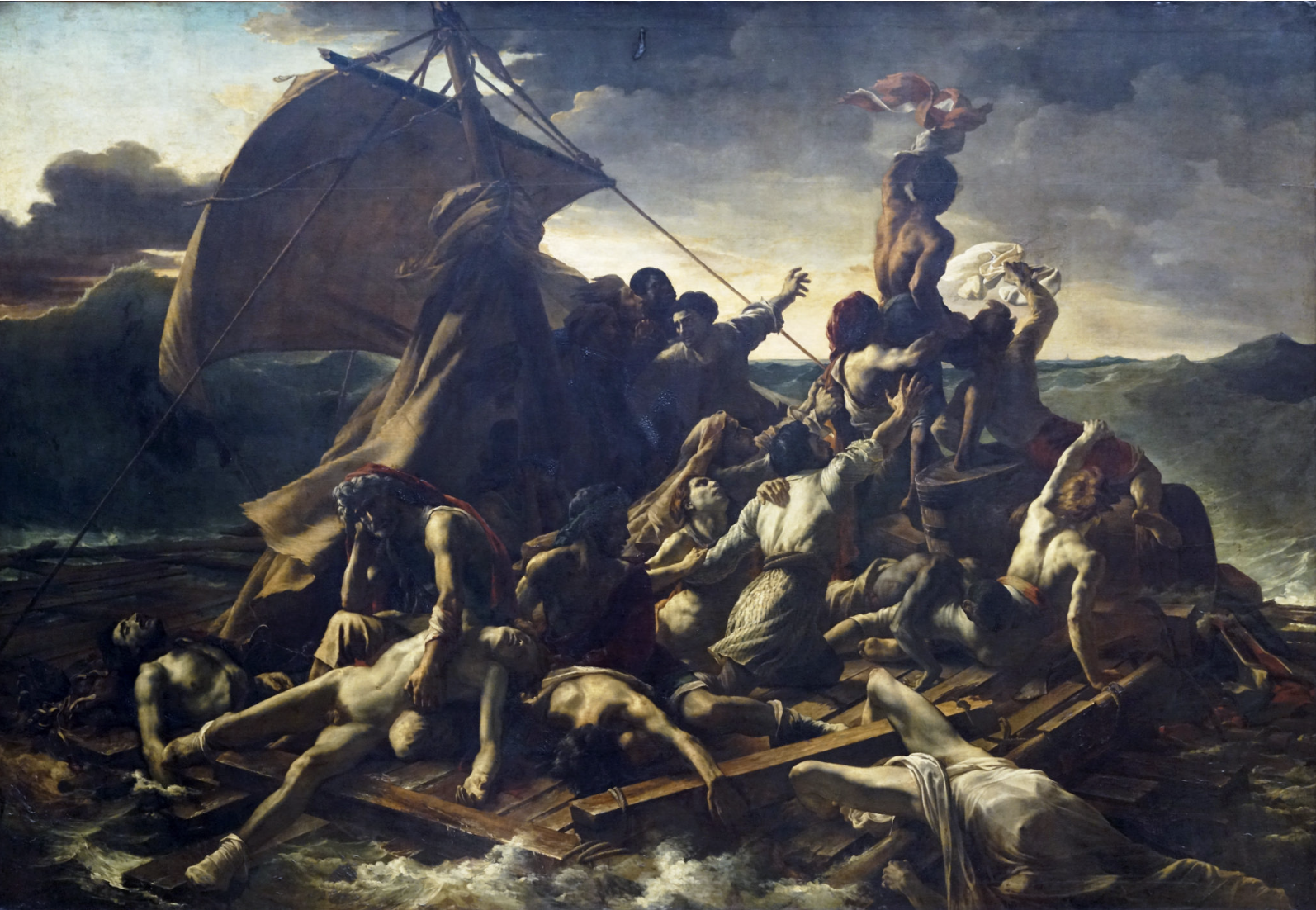
When have you waved your flag? I think about my students waiting to hear back from the colleges they applied to. I think about friends or family members waiting for a phone call to hear their doctor explain the test results. Hoping for the perfect parking spot to open up. Hoping for the wind to push the fire in a different direction. Hoping for a spouse. Hoping for children. For that pit in your stomach from interpersonal conflict to melt away. For healing and gentle rains. For freedom. For peace. We long for wholeness–a goal accomplished, a dream realized, a nightmare avoided–and we wait for it eagerly, though disappointment pushes our limits and labor pains make us scream.
The Bible Project explains how a biblical understanding of hope stems from two Hebraic words: “yakhal” means to wait, and “qavah” means to wait with expectancy. The Hebrew word “qav” references a rope or cord being pulled so tightly that it creates tension, and we wait for the moment when it breaks and the tension is finally released. I yakhal for the bus to come, and I qavah as I shiver and imagine getting into a warm bus. Both words are sprinkled throughout the psalms, the prophetic books, and the letters of Paul.3
Justified or not (“Please let Messi score another hat trick!”), we remain hopeful for a specific outcome. God, in his love and through his Spirit, sees our desires and groans with us as we wave our flags for rescue.4 We do not hope alone. However, The Bible Project further clarifies how biblical hope is primarily based on a person–God himself–no matter the circumstance or outcome that we long for. The prophet Hosea sets an example for us. He trusted the same God who rescued Israel from Egypt despite living in a time of great political oppression and instability. God declares, “There…I will make the Valley of Achor [“Achor” is Hebrew for “trouble”] a door of hope.”5 It’s the same God who breathed life into Adam from the ground, Lazarus from the tomb, and Jesus from the grave. Indeed, Christ, who defeated death itself, was the only person who could open the scroll–and he did.6 He is our greatest hope.
Every year, our Head of School commemorates the events of September 11th, 2001 for our students during our daily morning assembly. One year, he included this quote from Fred Rogers: “When I was a boy and I would see scary things in the news, my mother would say to me, ‘Look for the helpers. You will always find people who are helping…If you look for the helpers, you’ll know that there’s hope.’”7 The helpers challenge and encourage us to listen for the whispered hope through the noise–and to trust it.
The Messiah? In a manger? A whisper.
In Tracy K. Smith’s imagination, it is like listening for an old, old story:
We were made to understand it would be
Terrible. Every small want, every niggling urge,
Every hate swollen to a kind of epic wind.
Livid, the land, and ravaged, like a rageful
Dream. The worst in us having taken over
And broken the rest utterly down.
A long age
Passed. When at last we knew how little
Would survive us–how little we had mended
Or built that was not now lost–something
Large and old awoke. And then our singing
Brought on a different manner of weather.
Then animals long believed gone crept down
From trees. We took new stock of one another.
We wept to be reminded of such color.” 8
*
Sources
1 Tracy K. Smith, excerpt from “An Old Story,” Wade in the Water, 2018, https://www.poetryfoundation.org/poems/
147456/an-old-story-5b58c2f3a01c7.
2 Dr. Claire Black McCoy, “Théodore Géricault, Raft of the Medusa,” in Smart History, https://
smarthistory.org/theodore-gericault-raft-of-the-medusa/.
3 Tim Mackie, John Collins, “Yakhal / Hope,” The Bible Project, https://bibleproject.com/videos/yakhal-hope/.
4 Romans 8:26-27, New International Version (NIV).
5 Hosea 2:15, NIV, emphasis mine.
6 Revelation 5:1-5, NIV.
7 Melissa Butler, “Hope from the Helpers of the Educators’ Neighborhood,” Fred Rogers Institute, May 2020,
https://www.fredrogersinstitute.org/resources/hope-from-the-helpers-of-the-educators-neighborhood.
8 Smith, “An Old Story.”